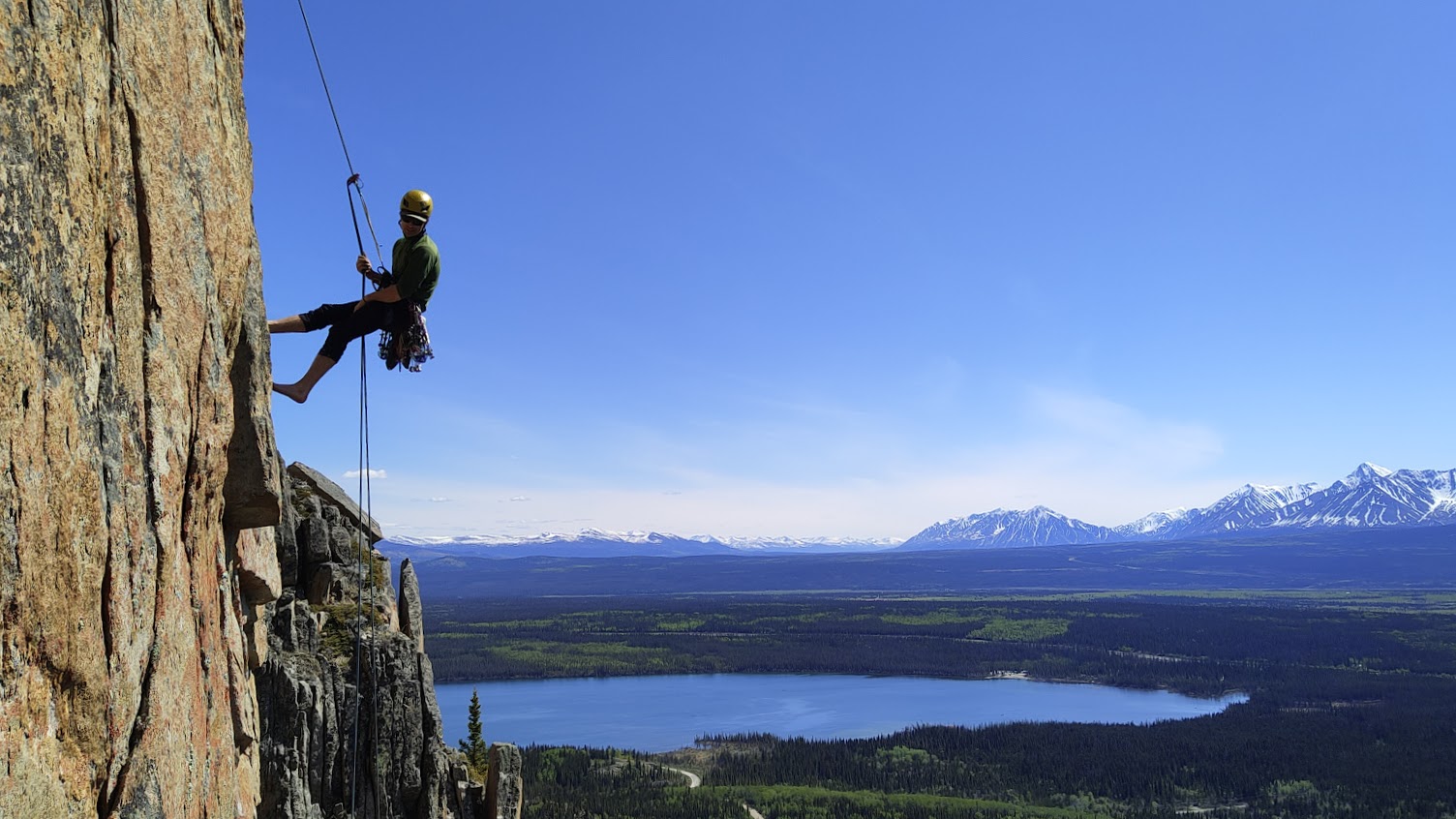
These trip reports take place on two separate dates: May 20th and June 4th, 2023
Late Spring 2023 was certainly the best early season I’ve ever had in my climbing career. After what seemed like a never-ending winter, the warm weather hit hard and fast. Most seasons, I’ve had to ease my way back into climbing, both mentally and physically. Climbing has never come to me naturally, I was a gamer as a teenager, not an athlete. I’m not one of those people that is undeterred by heights, I’m not ever more fit than I need to be and I’m often a giant ball of anxiety. The only reason I can really climb the way I do is because I’m stubborn and refuse to let all these things stop me from pursuing the goals that inspire me. But, my lack of natural athleticism means I don’t climb particularly hard. I’ve seen gym climbers get on real rock for the first time and flow their way up 5.11s. Meanwhile, my highest lead outside has been 11a for a long time and I’m unsure I’ll ever find 5.10s ‘easy’. I’m pretty ok with that, I value adventure over grades, but there’s also just the fact that climbing higher grades offers you more options and makes the lower grades feel more casual. So I was surprised to find, within the first couple sessions of climbing of the year, I was feeling pretty casual top roping my project from last year, Crucifix (which I then redpointed June 10th) and I was immediately hopping on gear routes near my limit. Before the season had even started in the territory, I headed down to Vancouver for a week for work and took a long weekend to hang out in Squamish. Nicole came down to meet me and we spent 3 days trying to dodge the rain, often unsuccessfully. I found myself onsighting a 10b gear route semi-casually, the same grade that was my previous highest redpoint for trad. What the hell was going on? I thought, this wasn’t like me, I didn’t know but I decided to take advantage of it.
CHUNDER GULLY
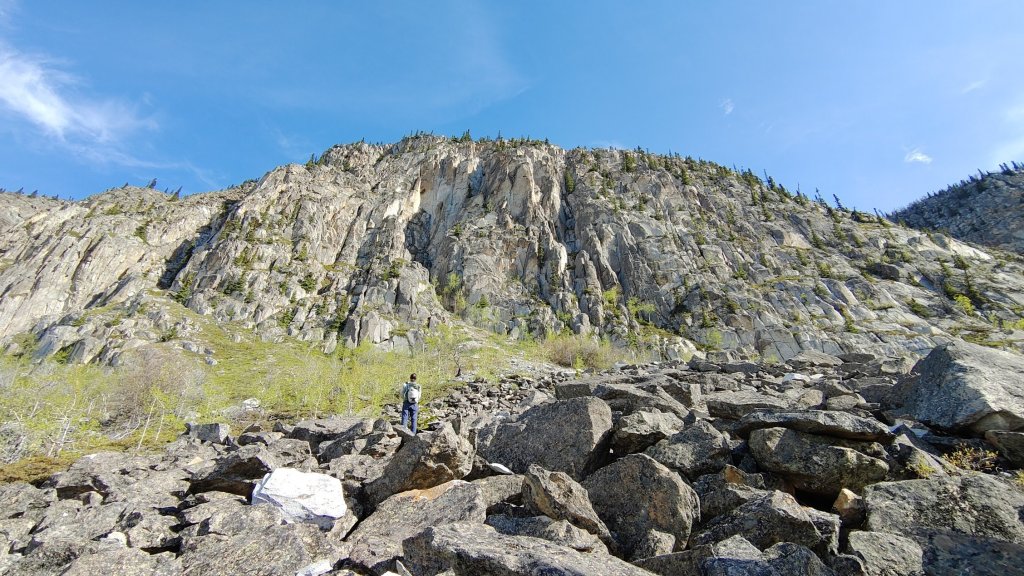
Chunder Gully on Paint Mountain is a bit of a mystical route, it’s considered THE classic traditional multipitch in the Yukon and yet it’s weirdly difficult to find many people in the general climbing populace who have climbed it. Originally climbed fairly recently in 2017 by Charles Kalinsky and Greg Barrett, it ascends the steepest, cleanest feature seen from the approach trail on Paint. The crux pitch is a 5.10- offwidth crack called “Chocolate Snot Rockets”. As a trad climber, it was of course on my list. However, my first full season in the Yukon saw me go from feeling pretty confident on granite crack, after a prior season in Squamish, to realizing I wasn’t as much of a hotshot jammer as I thought I was. Cracks in Squamish, even those in the 5.10 range, tend to be less than vertical, cutting through clean slabs. It’s a style that rewards good footwork moreso than brute strength (on most moderates anyway, don’t get me wrong, Squamish does have steep climbing). However, the vast majority of crack climbs in the Yukon tend to be pretty damn vertical, often with steep bulges at the cruxes (not to mention the Yukon is genuinely pretty sandbagged). This means your jams have to be solid as hell since you’re often hanging a lot more weight on them. I often tell people that the Yukon taught me how to be a much better crack climber than Squamish ever did. But it took an entire season to see the improvement, I climbed a single 10a trad route after a full season climbing trad here. I desperately wanted to climb Chunder Gully the previous year but the thought of climbing Yukon 10- offwidth was terrifying. Offwidth has to be one of the weirdest, least intuitive styles of crack climbing, and I had done very little of it. “Why does the crux have to be offwidth?” I often lamented to myself.
As I mentioned, it’s weirdly hard to find people to talk to who have actually climbed the route. Unlike down south, the MountainProject wasn’t exactly flush with comments with people giving expanded beta. But, after awhile, I would talk to the occasional person who had done it (and did some internet sleuthing) and found out that offwidth jamming techniques weren’t even necessary and you could easily hang or aid on gear at the crux. This eased my worries a little bit and with the momentum I had from such a strong start to the season, I decided to give it a shot.
I teamed up with Johnno, a recognizable face to most people in the climbing community, to head out there and give it a shot. Johnno had also climbed it previously and had valuable beta, especially for the rack. We ended up taking a single rack 0.3 to 5 with doubles 0.5, and 1-4. The chunkiest rack I’d certainly ever hiked up on a climb. But it was genuinely the perfect rack for the route, so I was happy to have every piece.
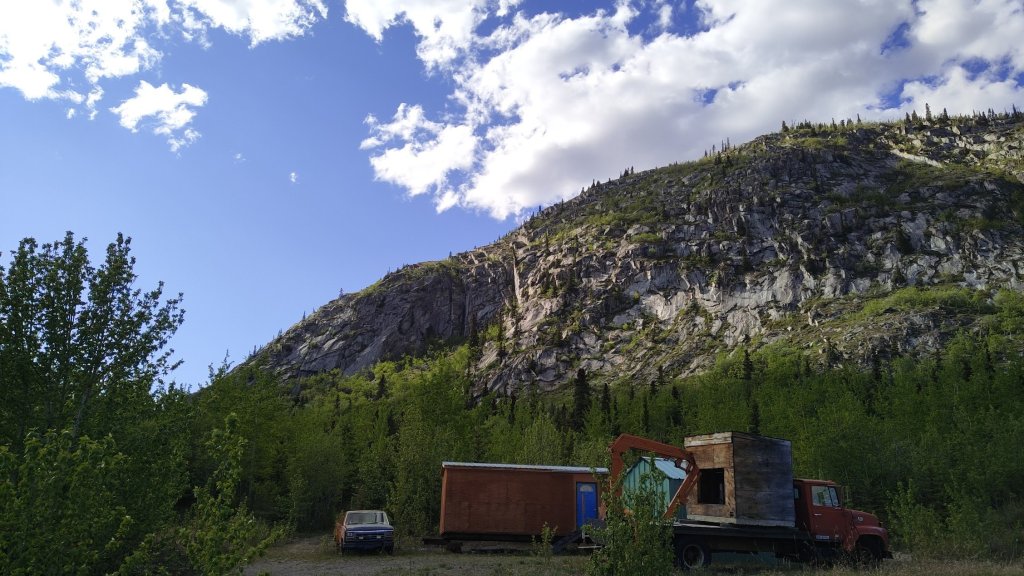
We arrived at the parking lot at around 9:30am, packed our bags for the day, and headed out on the western trail used for all the crags but Orange Corner. Chunder doesn’t have a developed trail and we ended up bushwhacking through some rose bushes and scrambling up some big boulders to reach the talus field draining from the canyon. I would be tempted next time to simply follow the approach for Buffalo Shoulder Buttress and just fork right above the trees toward Chunder but either way it’s not as much work as it looks to get up to the rock. As per it’s name, Chunder is a canyon/gully feature on the face. At it’s mouth it goes from a wide talus field to a more choked canyon with looser scree. To facilitate an easier approach, Charles and Co. installed fixed ropes on the left side of the canyon wall. While it’s not necessary, it’s certainly appreciated. You have to be careful in this section as it’s easy to kick loose rocks down and there’s not many places for someone below you to run.
We arrived at the base of the route at 10:40am and starting racking up. The line is extremely obvious, a crack splitting nearly the entire face above. Though the rock up the face is fairly clean by Paint standards, the amount of massive dagger shaped flakes above you is slightly alarming. Not that the shape particularly matters as no matter what, getting hit by a rock that size is going to fuck your day up. But the way they look is just ominous, you certainly wouldn’t want to to be in the gully if one of those things released. Pushing those mental images down, we started the climb. Instead of doing the extremely loose and dirty original start, we chose to go up the alternative first pitch “Fourthplay”, which is what Charles has told me is certainly the recommended way to do it. It follows a rib of clean rock and is largely bolt protected but requires a few awkward (to perform and protect) moves to reach the ledge below the main crack system. Regardless though, it’s a fairly chill pitch to get you into the meat of it.
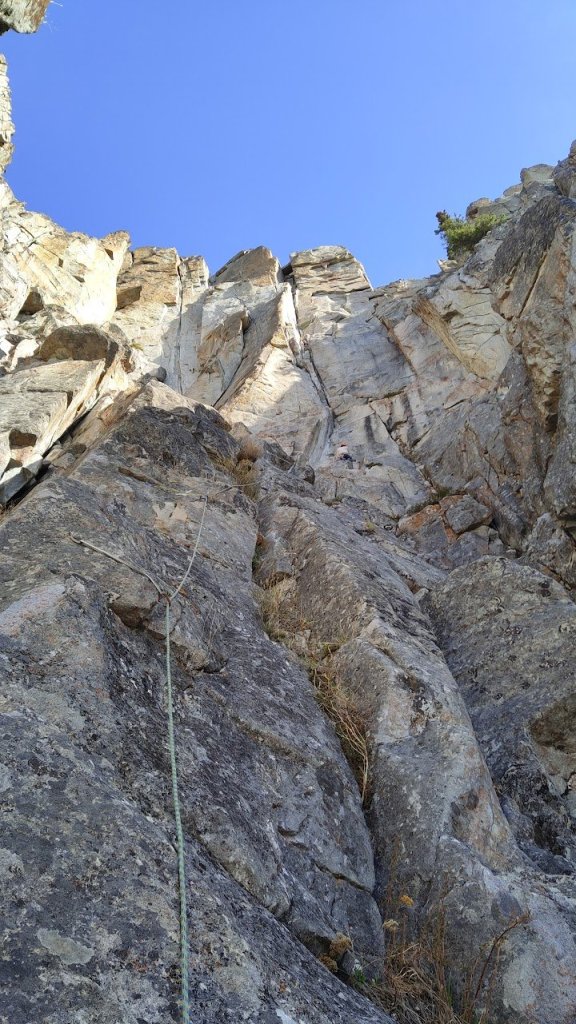
The next two pitches were mine to lead. Starting with a surprisingly steep 5.8 pitch. I was hoping for something cruisy to warm-up for the crux pitch but had a bit more trouble on this pitch than expected. You start in this weird, crossing corners feature which is the start of the major crack feature of the route. I remember the protection feeling a bit tricky but got a good #4 in. I call it ‘crossing corners’ as you have this roof/corner feature above slanting left and a right facing corner on your left shoulder, so they pinch together where the main crack forms. To me, the obvious line was to go through the crack but this ended up being extremely awkward. I felt fine going for a whip there but just couldn’t quite figure out the moves through. So, using a dubiously attached juggy flake, I pulled myself left onto the slabby face beside the right facing corner and did some easy slab moves back into the crack. This was a reasonable (and very cool and exposed) move but if that flake ever rips it’ll be a much harder pitch. From there it was straightforward cracks up to the next belay. Much of the pro on this section is placed between detached blocks within the crack. Hard to say if any of those pieces are bomber. Maybe cams would provide a compressive force holding the rock in? Maybe it’d rip out? Who knows but the climbing is relatively easy so an overall chill pitch.
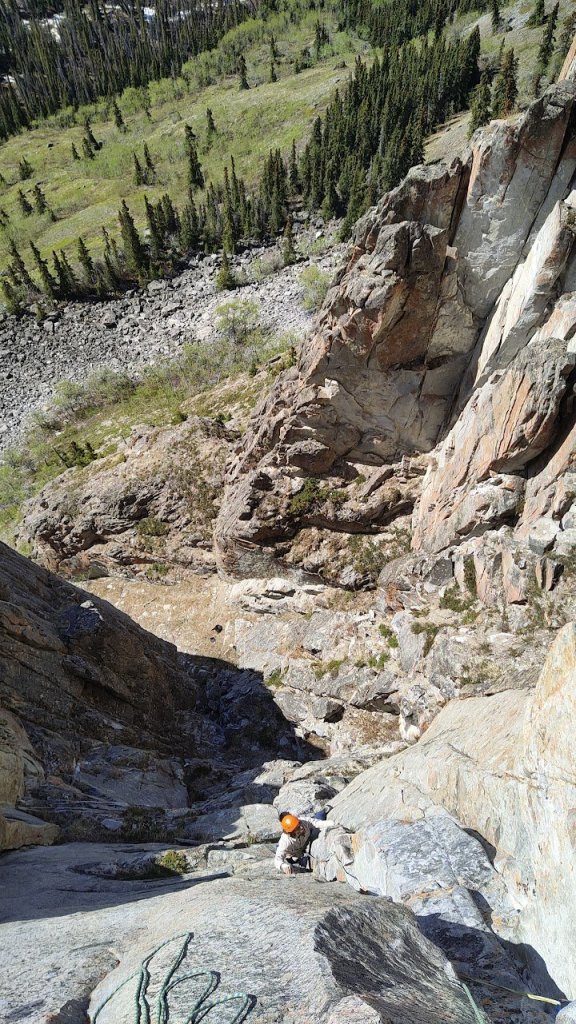
After Johnno pulled up onto the ledge, I eyed the the next pitch. This was the Money/Crux pitch of the route. The dreaded off-width. I reminded myself that it was easy enough to aid the crux if I really needed to and that calmed me. The start of the pitch requires you to pull a bulge with more gear placed in blocks but afterwards the crack is as clean as can be with great, but big, pro. As per the MP description, some ‘creative jams’ will get you through and I surprised myself with the onsight. I won’t lie, though it felt fairly smooth, I definitely had a couple moments where I was telling myself how much I hate offwidth. Likely the most difficult part was placing protection but it was the most well protected pitch of them all, I was extremely happy to have 2x#4s and a #5 for this one (just make sure you rack them all on your right side). You get an awesome, but slightly awkward, rest in a chimney section where it opens up before the crux. Feels like you could spend the whole day chilling in there. The only ‘offwidth’ technique you really need to do is chicken winging which feels fairly intuitive to me. Otherwise, there are lots of sneaky hand/fist jams in the back and even some sections of face moves that can let you take a break from the crack. After inching your way up, left shoulder in, to the slightly overhanging part of the crack (crux) you can then swing yourself out and rotate left to utilize the face holds, stemming up with great pro and onto easy terrain. The combination of techniques and the feeling of exposure as you look down the gully is amazing. An absolutely beautiful pitch.
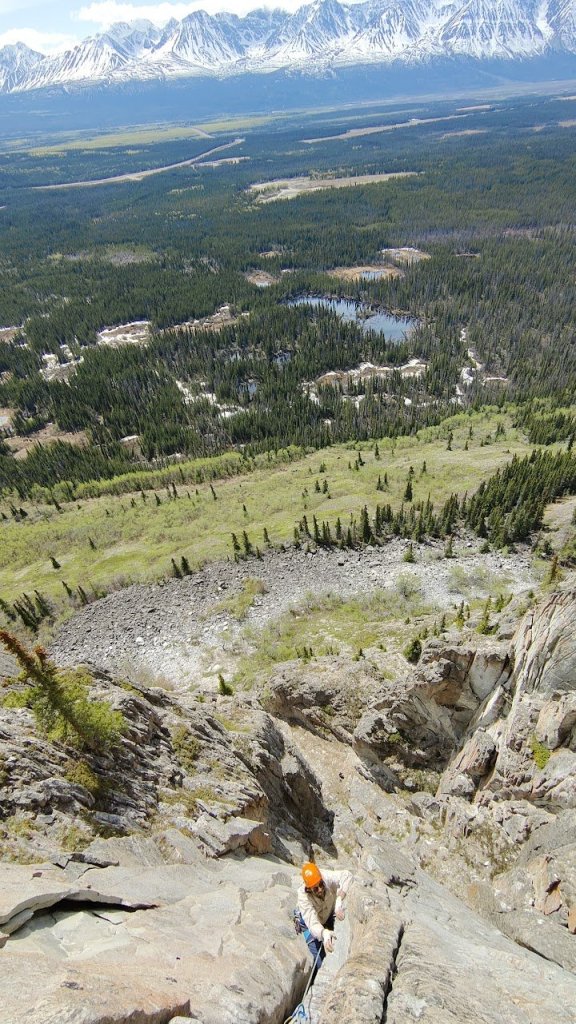
The final pitch was all Johnno’s, a fairly short and easy pitch known as the ‘frosty squeeze’ as it has you tunneling through a massive chockstone before topping out on the final ledge. Felt like a bit of filler but was worthwhile to finish things up. Though from the top of Chunder Gully pitch 3 you can easily access some much better pitches via an easy traverse, which will be described in the next part of the trip report. I followed and we took a moment to decide if we were going to rap through or over the chockstone (we went through). We finished up the rest of the rappels, reversed the approach, then ended our day up with dinner at Mile 1016 pub. Overall an awesome day and definitely a highlight of my Yukon climbing experience.
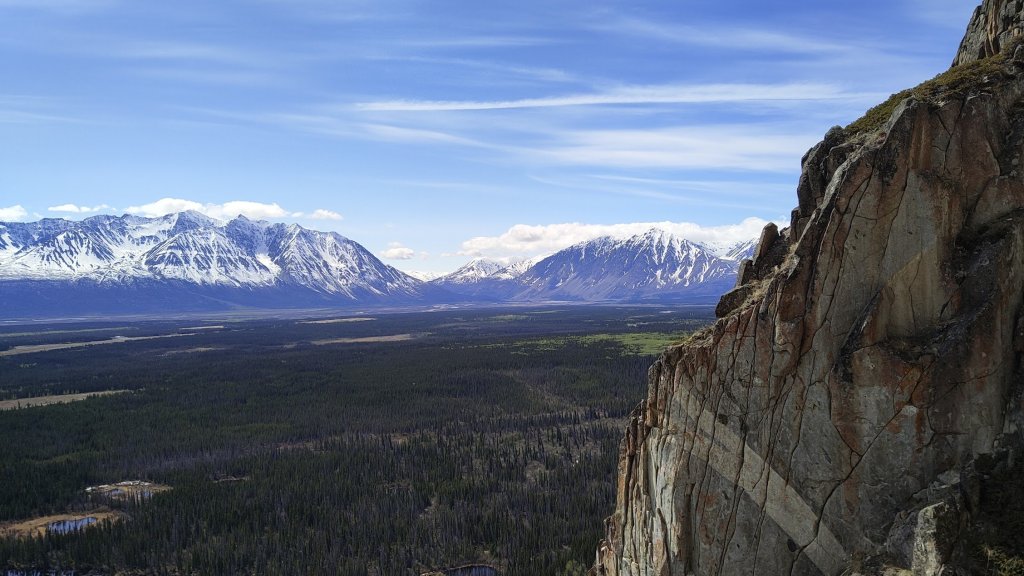
The Other Chunder Canyon Routes
While climbing Chunder Gully, it was hard not to notice all the adjacent rock. I’ve religiously researched most of these routes and was able to pick out the major features and commit them to memory for a future return trip. The rock looked much cleaner on that part of the wall and after a day of placing gear in detached blocks I was intrigued. That return trip came pretty soon, two weeks later, with Rob and I heading up to check them out. Once at the base of the routes again, we were shortly followed by Etienne and Jasper, who were there to climb “whatever you guys aren’t”. It was pretty neat to have another party nearby and thankfully the routes don’t crisscross so loose rock is generally not a concern. I’m not sure how often Chunder Canyon sees multiple parties but it’s likely not very common.
Figuring out the next line to climb took a bit of piecing together. Rather than developing them as distinct, cohesive lines; Charles, Vanessa, and Greg instead established multiple, parallel pitches that generally ended at the same ledges. Creating a bit of a choose your own adventure. I ended up picking what was generally the easiest possible line to the top (save for the last pitch), which requires a 10b pitch on gear and a mixed pitch with a 10d bolted crux. Overall, the line we chose took this path: Fourthplay -> Prince Albert -> Awesome Sauce -> Walk of Shame -> Constant Climax.
I took the first pitch since I was familiar with it, starting once again on Fourthplay. However, rather than cutting right, aiming for the crack of Chunder Gully, I headed straight up. After the initial bolted section to a rap anchor, the pitch becomes much looser/alpine. Overall it’s easy and safe but there’s significant run-outs on scrambling terrain and a fair bit of rope drag can occur. To get to these other pitches you need to aim for a ledge known as ‘Sacraledge’, following fourthplay passed one rap anchor, some scrambling, then another rap anchor, then a short, loose 5th class section to the anchor at the ledge. Overall, not a great pitch, but didn’t feel particularly scary or difficult and is necessary to get to the good climbing above.
After this pitch, you have 2 options for the next. One to the left (Prince Albert, 10b) and one to the right (Reach Around, 10c) to reach the ledge known as ‘the tip’. I’m sure you’re noticing a pattern here. This is because the feature you’re climbing on for this next pitch happens to be a giant, phallic shaped rock on the face. Paul Henstridge called it the ‘Black Dick’ (a play on the famous Black Dyke in Squamish) after an aid attempt on Reach Around in the 90s but it seems like Charles prefers his humour a little less on the nose.
Rob took the next lead, heading up left for Prince Albert. You start off with a blocky, overhanging section (which could likely be bypassed up easy ground to the left but what’s the fun in that?) pulling onto a slab covered in mostly shallow cracks. There is one bolt before the slab steepens into the upper crack section. Rob had a bit of trouble here as there are some thin, spicy feeling moves getting to the bolt. However, when I followed I was able to find a pretty good 0.4 placement that Rob had clearly climbed past, it’s a bit shallow but looks bomber, and would make those moves into the bolt feel a lot better. After that it’s some more thin climbing placing gear in scattered openings until you get to the crack feature up above. I had to admit I was glad I didn’t have this pitch as my lead, there is certainly decent gear all the way up but once you hit the bolt you don’t have a restful stance until you’re at the top. I could only imagine how much more strenuous the pitch would be placing gear. After the slab, you enter a burly crack. Again, good pro is found, but you are hanging from some dirty jams to place it. The pitch probably doesn’t get climbed that often, contributing to it’s dirtiness, and I certainly felt like I was going to slip out on a few occasions while following. Props to Rob for leading this one with minimal complaints.
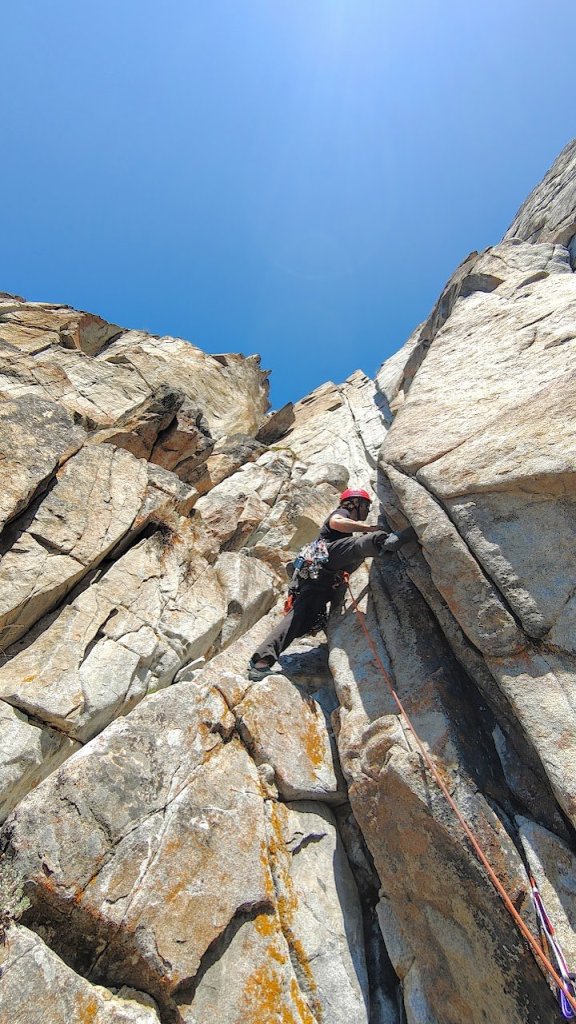
The arrangement of the leads was no coincidence, I knew the crux pitch was largely slab (which Rob hates) and evidently, Rob is a stronger crack climber than me, having cruised Prince Albert. Launching from the tip, I found myself immediately in an extremely blank, 3 bolt traverse slab sequence. This was my shit! It was extremely well protected with shiny bolts and feels like a well choreographed dance. At first it seems improbable but there’s only one way to do it, so you try it, and hopefully you succeed. Thankfully, I did, though frankly it seems like it would be easy to aid across this section if need be. Once past the traverse, you reach an arete, which is actually the upper edge of the corner on Chunder Gully’s crux pitch. I waved hello to Jasper and Martin. From here it’s a couple more bolts following the arete until you get to a short, easy crack feature protected by gear. Sadly, I ended up taking a fall at the last bolt. Though it’s certainly not the crux section, the bolting caused me to fall into a trap I find myself in commonly. The last bolt was in reach and being a wuss, I was hoping to clip it ASAP. The fall didn’t look that clean. I found myself downclimbing a couple times before committing to the moves and trying to go for the clip as soon as I could off of tenuous slab feet (but a juggy hand). But, as expected, my foot popped and I went for a ride. Frustrated with myself, but realizing the fall wasn’t that bad, I got back on and committed fully to the moves until my feet were resting on the nice jug my hand was on previously and I was able to easily clip the bolt below me. After pulling through the easy crack I found myself essentially at the top of P3 of Chunder Gully. From there, I linked into the short ‘Walk of Shame’ traverse. The description calls for a 0.5 placement as well as clipping the one bolt. However, I didn’t find the placement nor did I feel like it was needed. The only thing close to a 5th class move was right at the bolt and from there it was easy scrambling up to the ‘Juniper Ledge’.
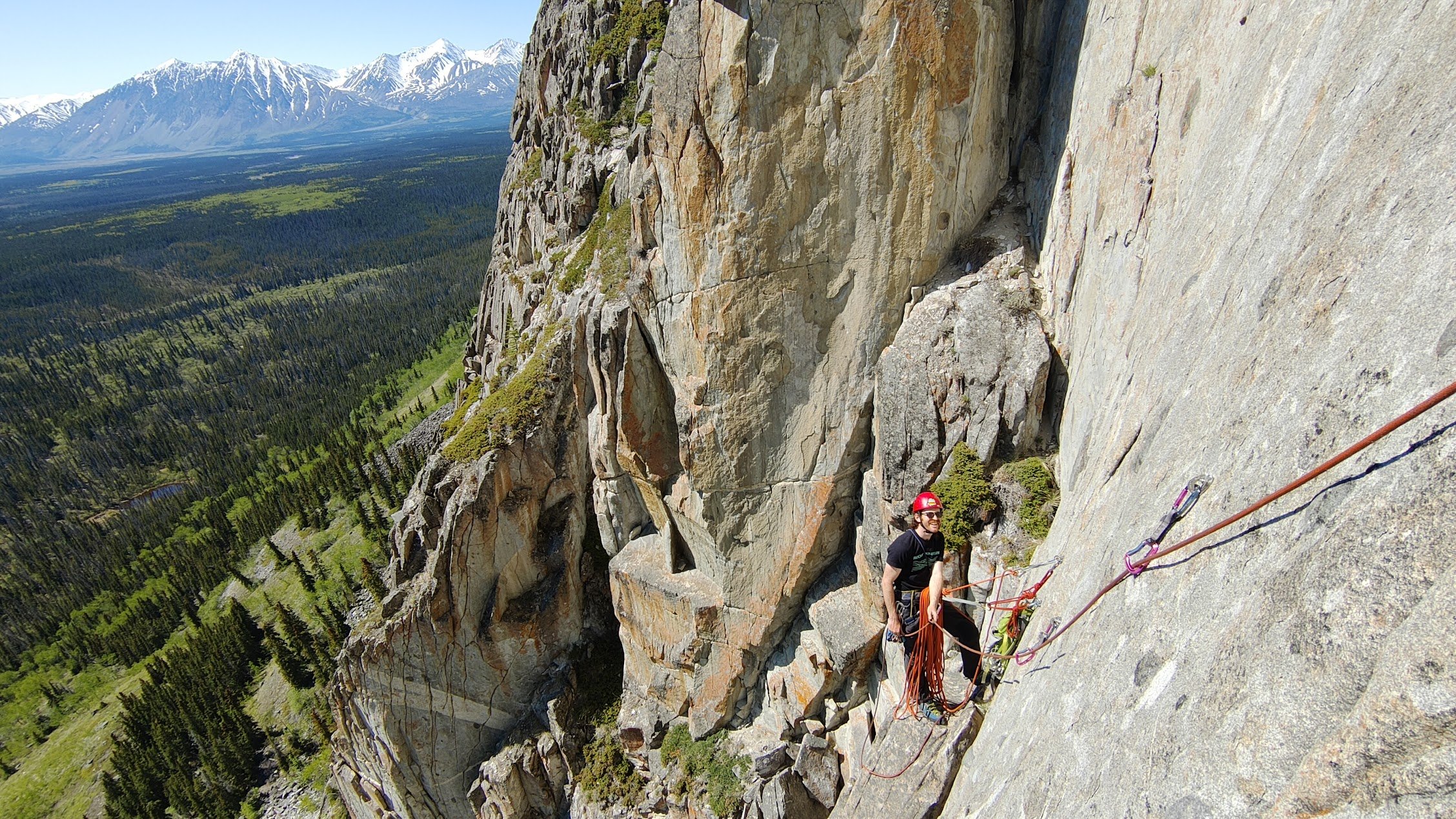
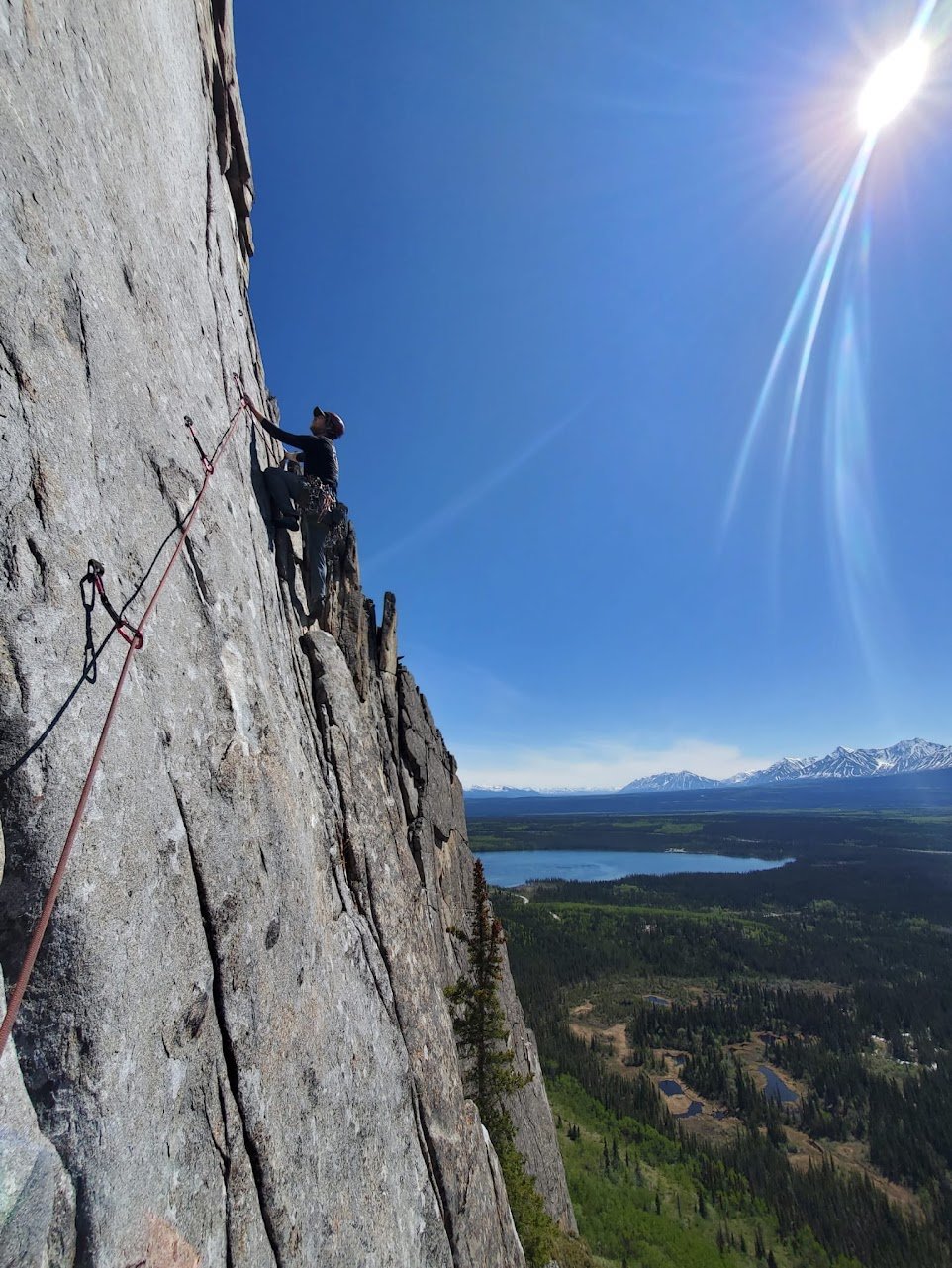
Me after pulling through the crux and Rob standing on ‘The Tip’
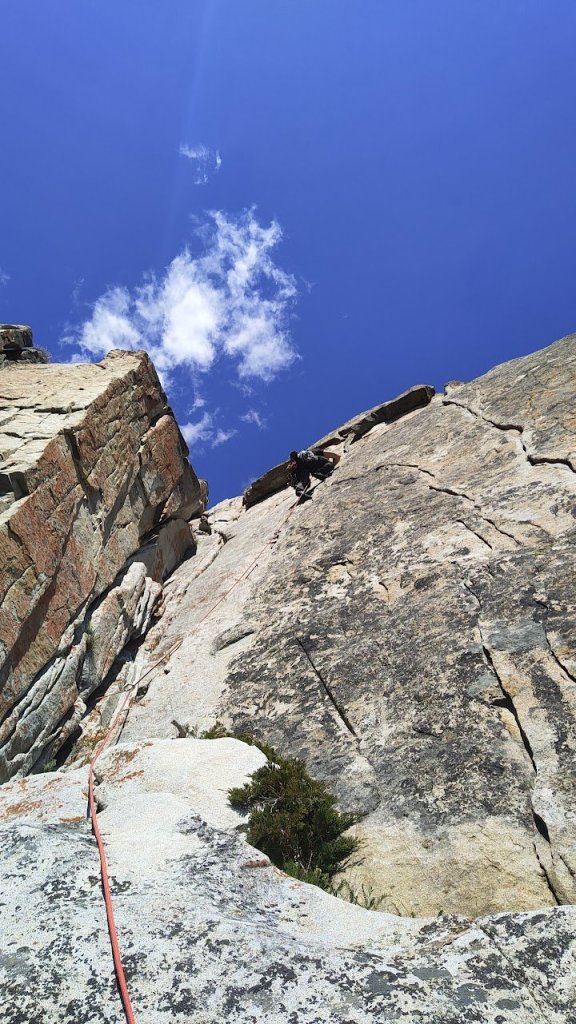
After reaching Juniper Ledge, it was Rob’s lead and we were faced with three choices. Pull Down, Not Out (5.7) to the left, Constant Climax (5.8ish) in the middle, and Nature’s Pocket (11b) to the right. PD,NO requires a 70m to rappel and NP was above our pay-grade for the day. So the obvious choice was Constant Climax. However, this was the money pitch in my mind. Though I only followed, it was clearly one of the best pitches of crack climbing in the Yukon and maybe anywhere. The pitch is somewhat hidden from the belay but with the MP description is easy to find. It’s right there, you just can’t see it because it’s a flake that folds over itself. The flake is quite thin in spots and that’s definitely not the most confidence inspiring for gear. But it feels very strong in most sections, with you able to place gear deep for more confidence. The crux of the pitch comes at a short roof section with great holds, gear, and exposure. An absolutely amazing pitch! Though I personally felt it was closer to 5.9, giving it that grade suggestion on MP which seems to have bumped it up on there.
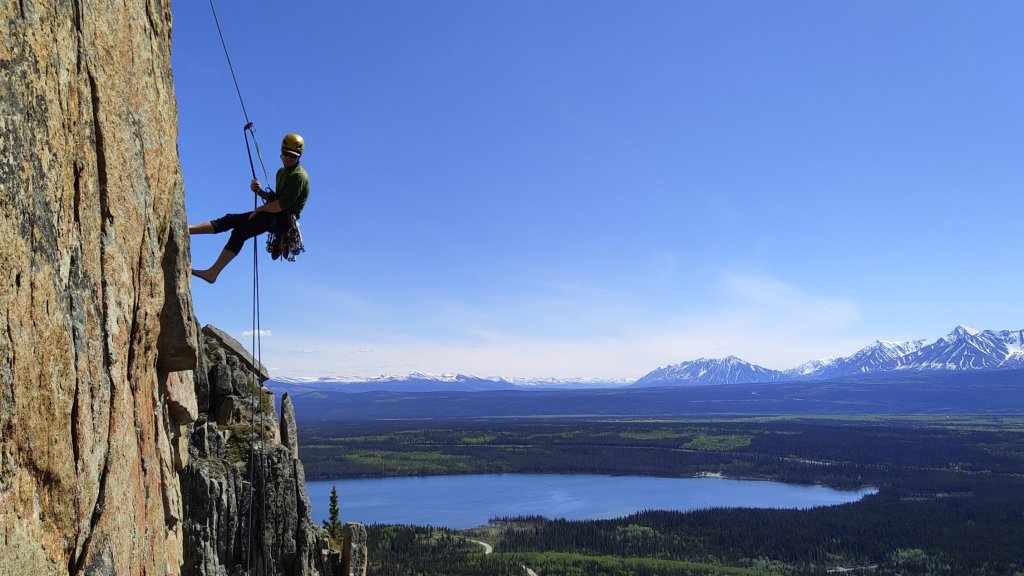
After topping out we rappelled the line without too much trouble. We missed one of the intermediate rappel stations but was able to get to the second one no problem. After climbing almost all of the road accessible, published multipitches in the territory (minus the harder pitches in Chunder and the scrappy upper pitches of some other routes), I have to say this is easily the most high quality multipitch line (gear or bolted) in the area. The first pitch is filler but from there it’s 3 high quality lines with great exposure, rock, and of course something about placing gear just adds that much more to it. Highly recommended!
 Noon Patrol